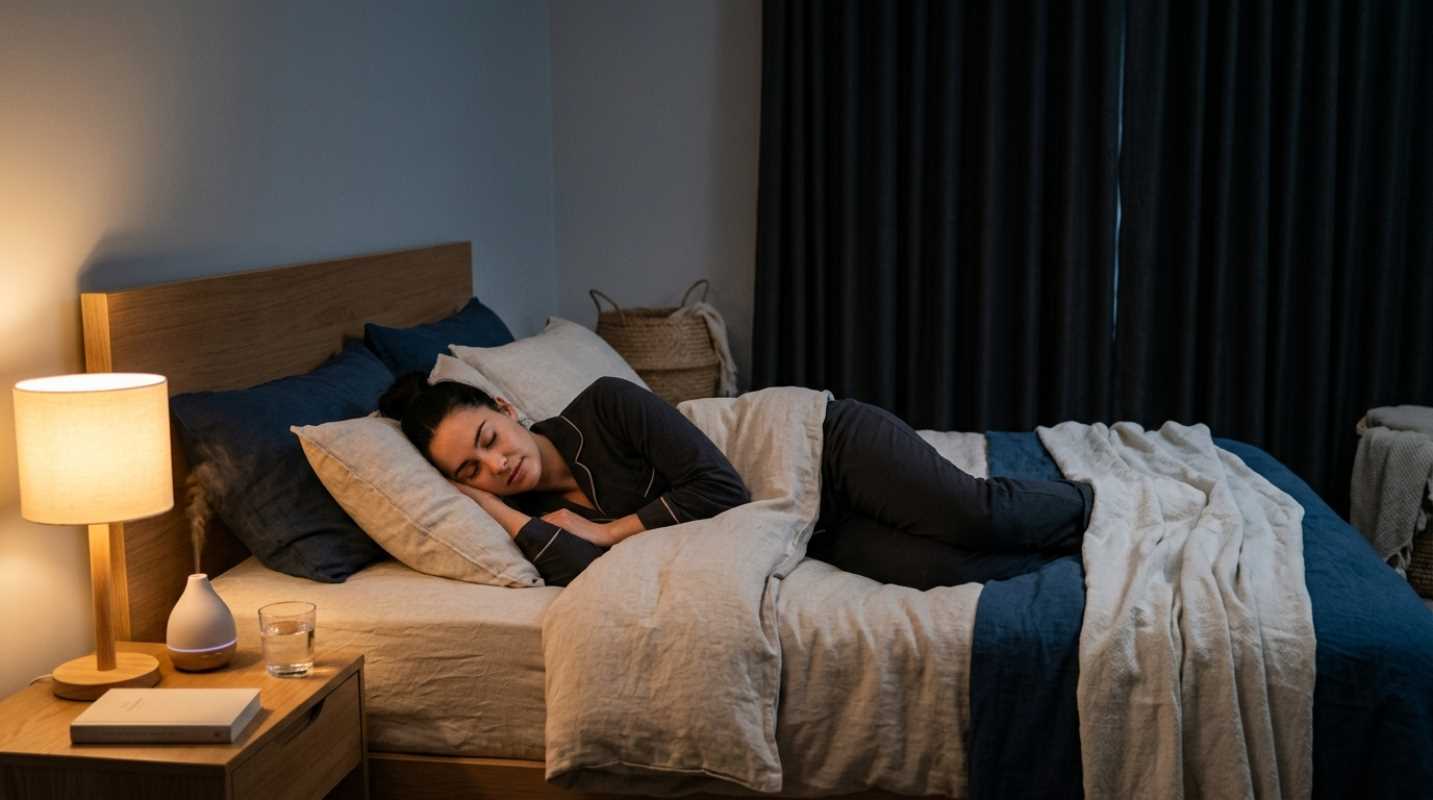
Have you ever spent a night tossing and turning, watching the minutes tick away on your alarm clock? You wake up feeling like you ran a marathon in your sleep. If this sounds familiar, you aren't alone.
We often blame stress or a late cup of coffee for our poor sleep, but the real culprit might be staring you right in the face. It is your bedroom. The connection between your physical surroundings and how deeply you sleep is incredibly strong.
People are starting to realize this on a massive scale. In fact, a recent survey by the Global Wellness Institute Sleep Initiative shows that 91% of frequent travelers are willing to pay up to 10% more for accommodations that actively improve their sleep.¹ Sleep is no longer just something that happens when you turn off the lights. It is a customizable pillar of health and longevity.
When you ignore your sleep environment, the consequences are real. Skipping a structured bedtime routine and leaving your bedroom in disarray makes you over 20% more likely to experience poor sleep.² So how do you fix it? Dr. Cheri D. Mah, a sleep physician at Stanford Lifestyle Medicine, boils the perfect sleep environment down to three simple words: dark, cool, and quiet.³
Making small changes to your space can yield massive results. Let's look at how you can transform your bedroom into the ultimate sleep sanctuary.
Mastering the Sensory Experience of Light and Sound
Light is the most powerful environmental cue for your body. Your eyes have special cells that detect light wavelengths and tell your brain whether to keep you awake or release melatonin, the sleep hormone.
Getting bright light at the right time matters. A landmark study found that every 30-minute block of morning sunlight you get before 10 a.m. helps shift your sleep cycle earlier by 23 minutes. This means you will fall asleep easier at night.
On the flip side, artificial light at night is highly disruptive. Research from Northwestern University shows that even a small amount of ambient light during sleep, like a glowing TV screen or streetlights peeking through your blinds, raises your nighttime heart rate and increases insulin resistance the next morning.
To protect your sleep cycle, try these simple adjustments
• The Blue-Out Rule: Remove all blue-light-emitting screens from your bedroom. This light mimics daytime and delays your natural melatonin release.
• Blackout Protection: Hang blackout curtains or wear a contoured eye mask. Dr. Cheri Mah points out that tiny slivers of morning light can cause micro-awakenings that ruin your REM sleep without you even realizing it.
• Sound Control: Keep your ambient bedroom noise under 30 decibels, which is as quiet as a library. If you use a sound machine to drown out street noise, keep the volume under 50 decibels. Playing white noise at 65 decibels or higher can actually raise your stress hormones and harm your hearing over time.
Temperature and Comfort as the Foundation of Sleep
Your body's internal clock is closely tied to your body temperature. To fall asleep and stay asleep, your core temperature needs to drop by about 1 degree Celsius (1.8 degrees Fahrenheit).
The National Sleep Foundation and the Cleveland Clinic recommend keeping your bedroom thermostat between 60°F and 67°F (15.5°C to 19.5°C).⁴,⁵ Most experts agree that 65°F (18.3°C) is the absolute sweet spot for deep sleep.
When you get ready for bed, your body naturally pushes heat out through your hands and feet. If your room is too hot, your body cannot dump this heat. You end up tossing, turning, and missing out on deep, restorative sleep.
Keep in mind that age changes these needs
• Older Adults: A study in the journal Science of the Total Environment found that older adults actually sleep best in slightly warmer rooms, between 68°F and 77°F (20°C to 25°C). Their sleep quality dropped significantly when the room went above 77°F.
• Infants: To keep babies safe from overheating, keep their nursery between 60°F and 68°F (16°C to 20°C) with light layers.
Dr. Brian Chen, a sleep specialist at the Cleveland Clinic, also warns that eating sugary treats or drinking caffeine late in the day raises your core temperature, making a warm room feel even worse. To stay cool, choose breathable bedding made of bamboo, eucalyptus, or long-staple cotton, and use a mattress that does not trap body heat.
Decluttering Your Bedroom for Peace of Mind
Your mind needs to feel safe and relaxed to let go of the day. A messy, cluttered bedroom keeps your brain on high alert.
Sleep psychologists often talk about stimulus control. Your bed should be a space reserved only for sleep and intimacy. When you work, watch television, or scroll through social media in bed, you train your brain to associate your mattress with stress and focus.
Try to keep your bedroom as minimalist as possible. Store work files, laptops, and exercise gear out of sight. A clean, organized room sends a clear signal to your brain that it is safe to power down.
Actionable Sleep Environment Tips for Longevity
One of the most overlooked parts of sleep hygiene is the air you breathe. A massive global review led by Dr. Junxin Li at the Johns Hopkins University School of Nursing looked at 1.2 million adults across six countries. The researchers found a direct link between breathing air pollutants, like fine particulate matter (PM2.5), nitrogen dioxide (NO2), and carbon dioxide (CO2), and getting shorter, poorer sleep.
When you close your bedroom door and windows for the night, CO2 levels from your breathing can quickly climb to 2,500 or 3,000 ppm. That is three times the healthy indoor limit. A study in the journal Building and Environment found that every 100 ppm increase in CO2 drops your sleep quality by nearly 0.3%. This is why you sometimes wake up with a headache or feel groggy even after eight hours in bed.
To fix this, keep your bedroom humidity between 30% and 50%. If the air is too dry, your nasal passages dry out, leading to mouth breathing and snoring. If it is too humid, you invite dust mites and mold. Use a HEPA air purifier to clean the air, and leave your bedroom door cracked to let fresh air circulate. You can also use lavender needed oil in a diffuser, as studies show lavender helps increase your deep, slow-wave sleep.
If you are ready to upgrade your bedroom, here are some of the best tools to help you build your ultimate sleep sanctuary.
Your Path to a Restorative Night
Optimizing your sleep environment is one of the most effective ways to protect your long-term health. When you control the light, sound, temperature, and air quality in your bedroom, you give your body the exact tools it needs to repair and recharge.
You do not have to change everything overnight. Start with one simple adjustment today. Lower your thermostat by a couple of degrees, put your phone in another room, or hang a set of blackout curtains.
Prioritizing your sleep is not a luxury. It is a non-negotiable foundation for a healthy, energized life. Your body and mind will thank you tomorrow morning.
Sources:
1. Global Wellness Institute Sleep Initiative Trends
https://globalwellnessinstitute.org/global-wellness-institute-blog/2025/04/02/sleep-initiative-trends-for-2025/
2. Purecare Sleep Statistics
https://www.purecare.com/blogs/pure-wellness-journal/sleep-statistics
3. Stanford Lifestyle Medicine Bedroom Changes
https://lifestylemedicine.stanford.edu/bedroom-changes-sleep-routine/
4. Cleveland Clinic Best Bedroom Temperature
https://newsroom.clevelandclinic.org/2026/05/14/best-bedroom-temperature-for-sleep
5. Sleep Foundation Bedroom Environment
https://www.sleepfoundation.org/bedroom-environment
*This article on Answerhaus is for informational and educational purposes only. Readers are encouraged to consult qualified professionals and verify details with official sources before making decisions. This content does not constitute professional advice.*